
You don't have to be picked
Spectrum is a year-round engineering program, not a selective club. It is open to every student at St. Agnes — no application, no interview, no teacher recommendation, no prerequisite course. If you want in, you're in.
St. Agnes Academy · FRC Team 3847
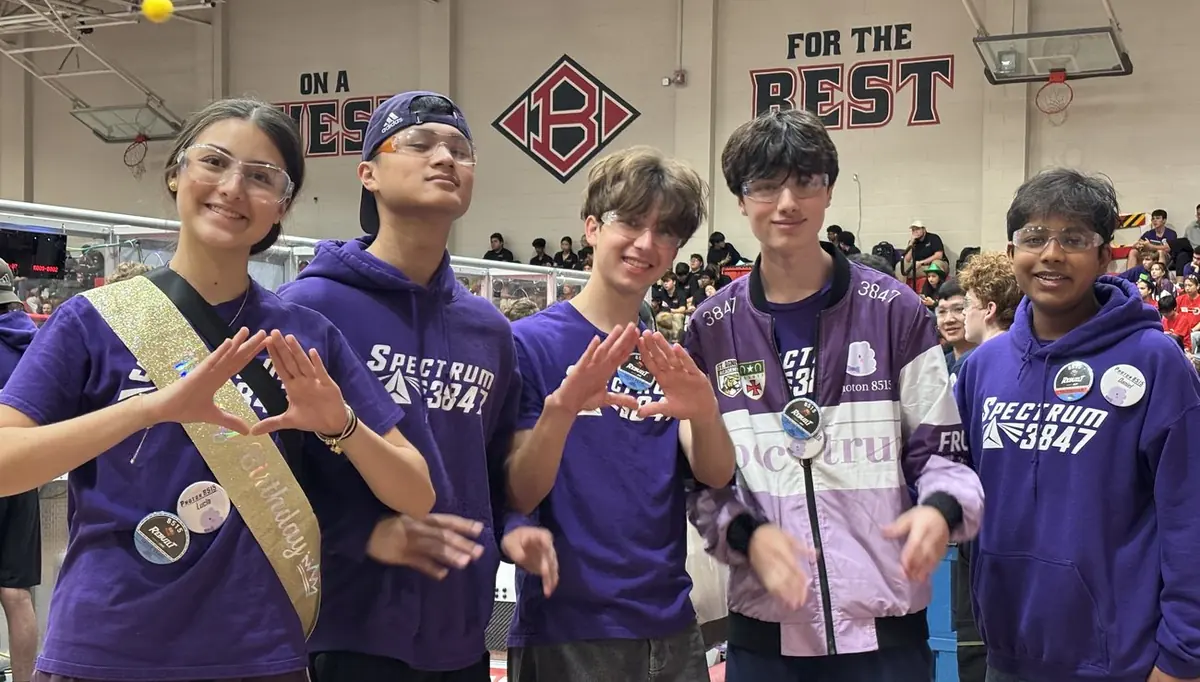
Spectrum 3847 is the robotics and engineering team St. Agnes started in 1996 and has co-founded and co-owned since 2011. There are no requirements to join. No application, no tryout, no prerequisite class. You don't need to be good at math or science. There is a role on this team for everyone — and 42% of the roster are young women.
The interest form takes about a minute and commits you to nothing. It just tells us you want to hear more.
Before you talk yourself out of it
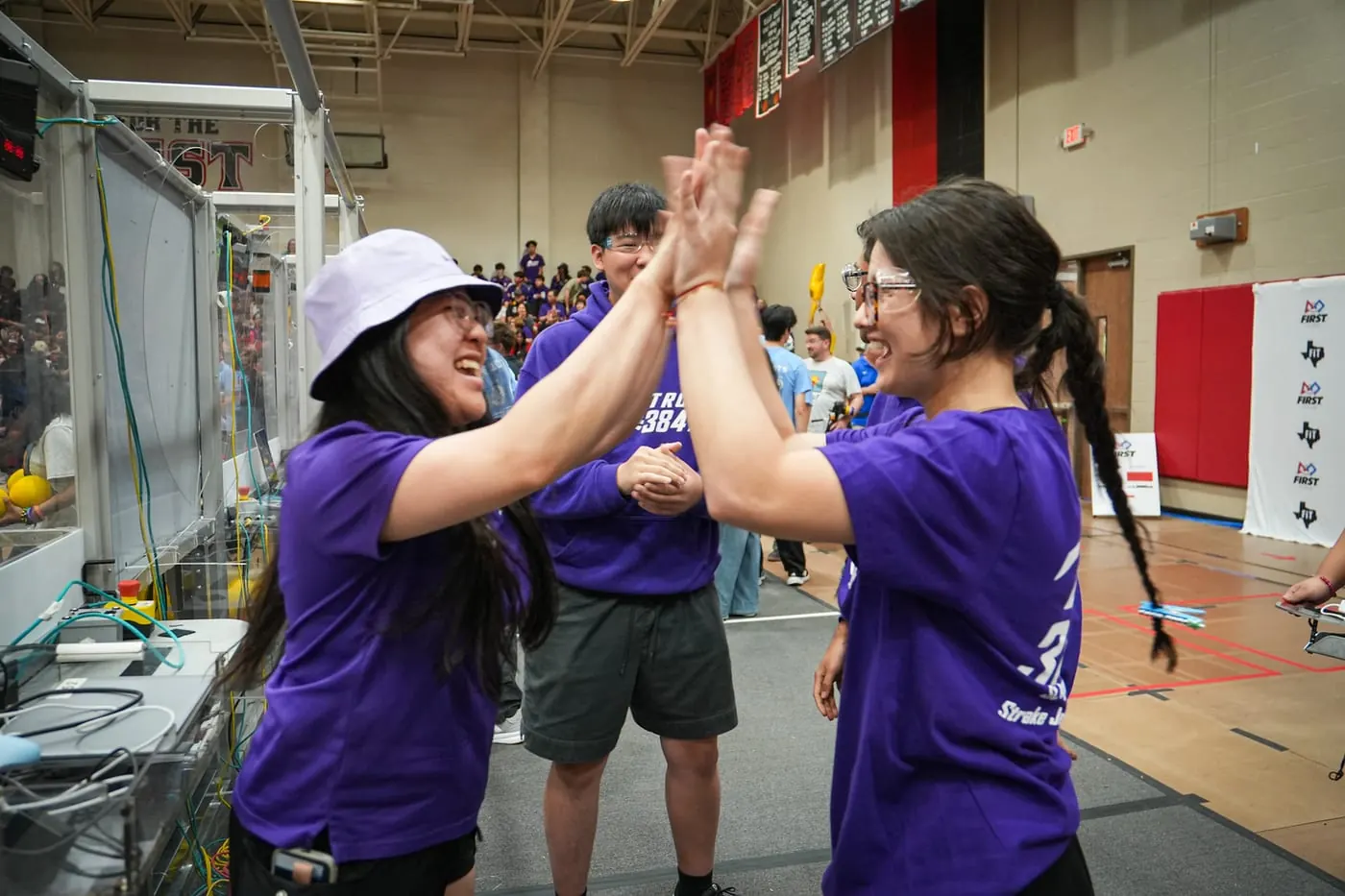
Spectrum is a year-round engineering program, not a selective club. It is open to every student at St. Agnes — no application, no interview, no teacher recommendation, no prerequisite course. If you want in, you're in.
Nobody looks at your grades. The team writes and publishes its own beginner training and it starts from actual zero — "What is FRC?", "Intro to CAD", "Intro to Java", "Intro to the Spectrum Shop", building a bumper corner, running a 3D printer.
Somebody has to shoot the photos, run the pit, write the awards submissions, plan the strategy, and teach kids at summer camp. There is a role on this team for everyone, and plenty of them never touch a wrench.
The team you'd be joining
Find your job
A robot is maybe half of what this team does. Pick the thing that already sounds like you — you can change your mind later, and most people do.
The shop: a 1200 W fiber laser, a waterjet, a printer farm, an in-house powder-coating booth. Beginner shop training starts with a bumper corner and a rubber-band car.
CAD in Onshape — the same tool professional engineers use. Every model the team makes is published publicly, so your work becomes a portfolio you can point a college at.
Java, on real hardware, split into groups like drive tuning, autonomous path planning, and vision. "Intro to Java Programming" assumes you have never written a line.
A drive team is up to five people. Photon 8515 deliberately rotates its drivers between matches so more members get the controls, and first-year students take those roles.
Strategy and scouting: watching every other robot at an event, logging what it can do, and telling the drive team who to pick for an alliance. Half analysis, half argument.
The pit is the team's storefront at a competition. Someone is always there, because judges and other teams walk up and ask questions all day. It's the most social job at an event.
Media: photography, video, social. The team's media work gets credited by name in the build blog, and there are 140,000 photos and videos in the public gallery to add to.
Spectrum has published a daily build blog every season since 2012 — students supply the articles, photos, data, and slides. There's a whole Awards track for the students who'd rather write than weld.
SPECTacular, the team's free two-week summer camp for 3rd–8th graders, has been designed and taught by Spectrum students since 2012. Members have also volunteered at 92 robotics events.
There are no permanently assigned sub-teams and no year-round captains. The structure is deliberately flat, which is how a student ends up writing code on Tuesday, running the mill on Wednesday, and shooting photos at a competition on Saturday.
Your first year
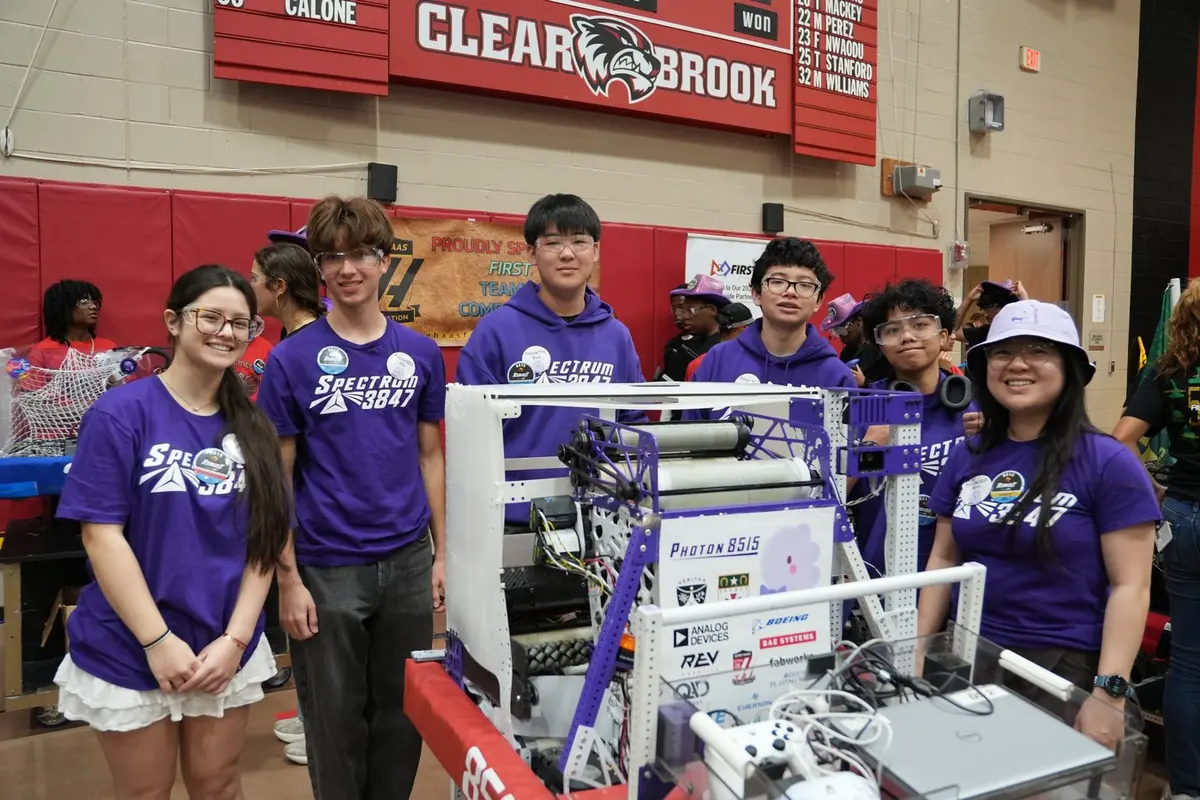
On a team of 84 students, the easiest way to fail a new member is to let her spend a season watching. So in 2021 Spectrum created Photon 8515 — a second, real FRC team where first-year students design, CAD, program, and assemble their own competitive robot and take drive-team roles at two district events.
Every Photon member is a Spectrum member and every Spectrum member is a Photon member. It isn't a junior tier — it's where a first-year student gets to be the one making the call. More than ten other FRC teams have copied the idea since.
Seven training tracks with slides and video: FRC basics, controls, design and CAD, build, strategy, media, awards. Every one has a beginner module that assumes no background.
Your own mechanism on Photon 8515, and drive-team roles at two district events. The team builds four machines a season on purpose, so more students own a real build instead of watching one.
Squad leads act as project managers on one of five mechanisms — drivetrain, intake, indexer, launcher, climber. You pick your squad on a form, and you can say you want to lead it.
You won't be the only one
St. Agnes has fielded an engineering team since 1996, eleven years before Strake Jesuit had one. In 2011, after three years of competing against each other in BEST Robotics, students from both campuses set the rivalry aside, secured sponsors, won over two administrations, and launched one joint FRC team. St. Agnes is a Principal Founding Partner of Spectrum — not a guest.
Today 42% of the roster are young women, and that number counts drive team, CAD, and fabrication — not clipboards. The team also runs Girls' Lab Days specifically for St. Agnes students, and every summer the Texas Robotics Invitational that Spectrum hosts opens with the Girls' Drive, a tournament in which robots may only be driven by female team members. 82 female-led drive teams have competed in it since 2024.
Janet Garcia found engineering on this team. She graduated in 2022, now interns at NASA, and mentors another FRC team.
Spectrum 3847 · 2026 Impact Magazine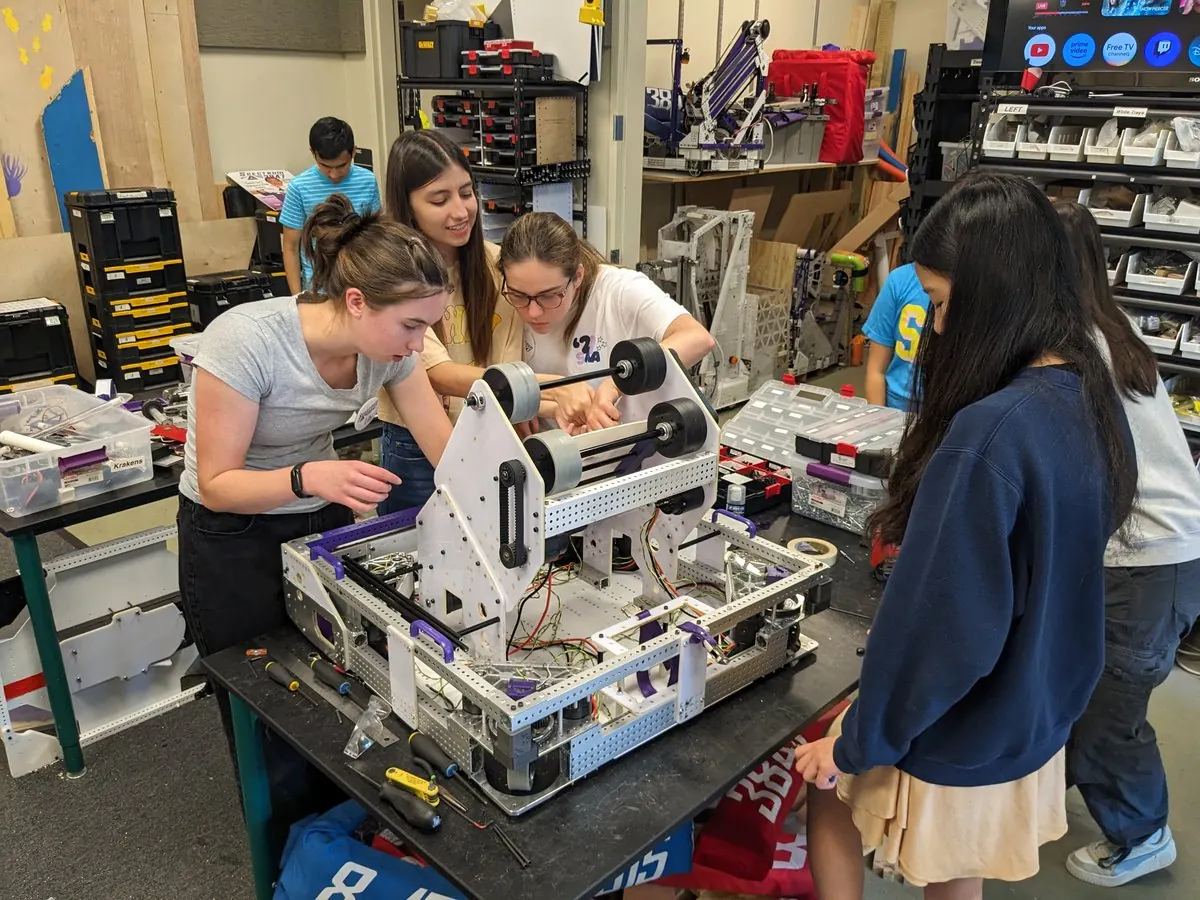
The honest logistics
The after-school schedule is deliberately flexible so students can carry robotics alongside sports, music, and student leadership — the team credits that flexibility as a big part of why people stay. Even during build season, the weekly all-team design recap is Monday at 6 pm and the lab closes at 7 so everyone gets an early night. Once a month, "FIRST Friday Fun" is purely social.
The team runs on Slack, so you can follow along and ask questions before you ever set foot in the lab. And a real amount of the year has nothing to do with robots: Houston Food Bank shifts — 18,000 meals packed in a single day — a 2,800-can CANstruction sculpture, and 425 3D-printed toys for Toys for Tots.
For the record
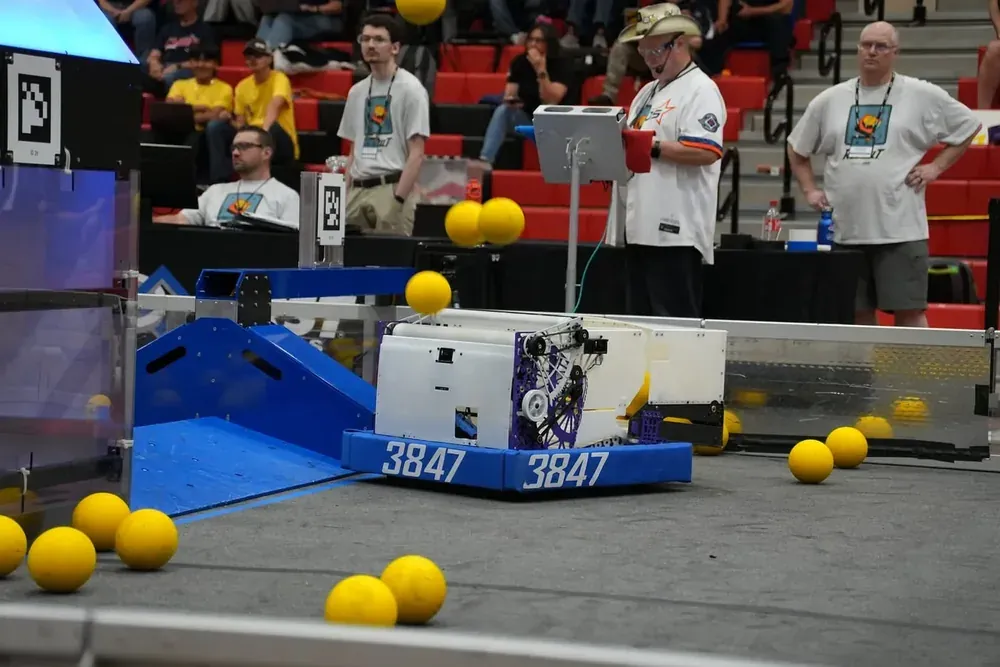
In 2026 Spectrum competed at four events, won the Friendswood district event, took a Quality Award and a finalist finish at League City, reached the district championship finals, and played the Curie Division at the FIRST Championship. Photon won the Gracious Professionalism Award at its Houston district event. Across fifteen seasons: 44 judged awards and 41 medals.
Spectrum also gives all of it away. It published FRC's first daily build blog in 2012 and hasn't missed a season since, releases the full CAD and code from kickoff onward, co-founded the Open Alliance in 2020, and hosts the Texas Robotics Invitational every June. Students write it, shoot it, and present it.
Every team member has a special place in the process and creation of our robots.
Spectrum 3847 mission statementHow to join
You don't have to do all three today. The first one is genuinely just "tell us you're curious."
The St. Agnes Student Spectrum Interest Form. About a minute, and it commits you to nothing at all — we'll follow up with what's happening next and when you can come see the lab.
Open the interest form →Slack is where the team actually lives — every mechanism squad has a channel, meetings run as Slack huddles, and it's the fastest place to ask a question and get a real answer from a student.
Join the Slack →The full St. Agnes roster registration form. This is the one that formally makes you a member of the team. Do it whenever you've decided — you can fill out the interest form first and take your time.
Register for the team →Straight answers
You do not need to know which one yet.
Spectrum 3847 · St. Agnes Academy & Strake Jesuit College Preparatory · Houston, Texas